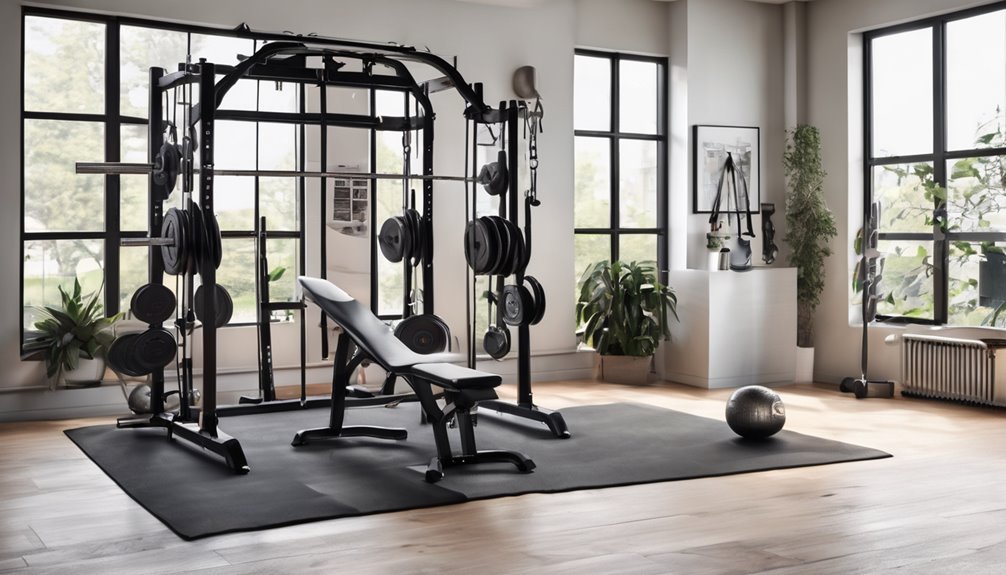
Looking for the five best load-bearing racks for serious strength in 2025? You’ll get a rugged lineup: a multi‑functional Power Cage with J‑hooks, dip handles, landmine, and optional cable pulley; Mikolo’s 2000 lb dual-pulley home gym; Sportsroyals’ 1600 lb cage with adjustable cable crossover and training attachments; a Power Cage Home Gym with dual pulleys and versatile attachments; and a LAT‑pulldown enabled multi‑function Power Cage. Each delivers solid construction, safety, and year‑round versatility—stick with this guide to see why they stand out and what to pick for you.
Key Takeaways
- Power Cage options offer 1,000–2,000 lb capacity with reinforced 50×50 mm frames and wide bases for stable full-strength training at home.
- Dual or independent pulley systems (cable crossover) expand exercise variety without overloading uprights.
- All-in-one designs combine rack, pull-up bar, dip station, landmine, and storage to maximize space-efficiency.
- Laser-marked, adjustable heights (often 9–30 positions) ensure precise setup for squats, benching, and pulls.
- Proper assembly guidance, warranty coverage, and modular attachments influence long-term performance and safety.
Power Cage: Multi-Functional Power Rack with J-Hooks, Dip Handles, Landmine Attachment, and Optional Cable Pulley System for Home Gym
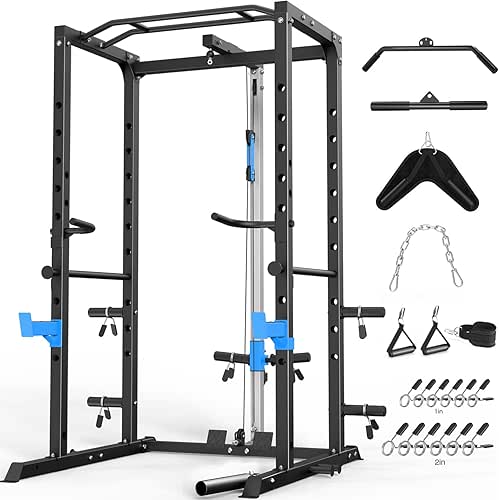
If you want a truly versatile powerhouse for a home gym, this Power Cage stands out with its multi-functional design and optional cable pulley system, letting you switch from heavy squats to cable-assisted accessory moves without changing machines. You’ll get a 1.5mm steel frame, 50mm x 50mm uprights, extra reinforcing tab, and wide bases that resist tipping. With 1000-pound capacity and 10-level j-hook/safety bar adjustment plus 3-level dip handle height, you tailor every set. It includes a landmine, tricep rope, ankle strap, T-bar, pulley, cable handles, and storage pegs for organization. It suits garage, basement, or outdoors, expanding exercise options.
Best For: Home gym enthusiasts seeking a versatile, heavy-duty power cage with integrated attachments and a 1000-pound capacity for full-body training.
Pros:
- Highly versatile with J-Hooks, dip handles, landmine, and optional cable pulley system for varied workouts.
- Strong construction: 1.5mm steel, 50mm x 50mm uprights, wide bases, and 1000-pound capacity.
- Convenient organization and setup features: built-in weight plate storage pegs and included accessories.
Cons:
- Requires ample space in garage/basement or outdoor area due to its size.
- May involve assembling multiple components and boxes during delivery.
- Some users might prefer more incline/decline bench compatibility or additional optional attachments beyond what’s included.
Mikolo Power Cage with Dual Pulley System (2000LB) Home Gym Cable Crossover
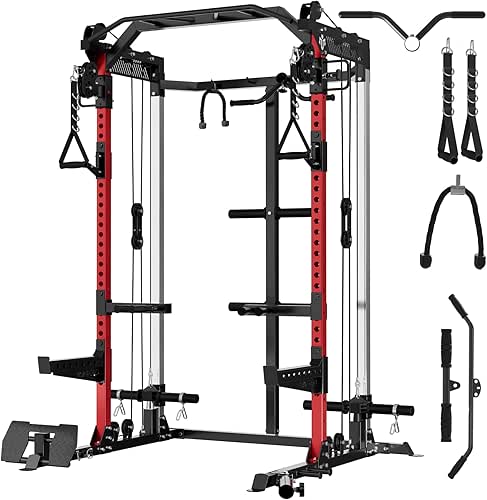
The Mikolo Energy Cage with Dual Pulley System stands out for home gyms that want serious versatility without sacrificing floor space, thanks to its space-saving half-rack design. You get an independent 1:1 pulley system on both sides, so the weight you lift equals the weight loaded, effectively doubling your training options. With up to 2000 lbs capacity, it supports heavy work. This 4-in-1 unit blends a power rack, multi-grip pull-up bar, cable crossover, and 360° landmine, plus a upgraded pulley system for smooth, protected moves. The frame features 2×2 columns, 2 mm tubing, 30 height options, and clear digital markers. Includes storage, accessories, and broad exercise versatility.
Best For: Home gym enthusiasts seeking a space-saving, versatile 4-in-1 power rack with a heavy-duty dual pulley system for serious strength training.
Pros:
- Independent 1:1 dual pulley system on each side expands training options and allows advanced techniques like supersets and drop sets.
- Space-saving half-rack design with convenient 30 height options and integrated storage to minimize floor footprint.
- Wide accessories lineup (dip bars, J hooks, T-bar row, multiple pull-up options) enables a broad range of exercises from compound lifts to cable work.
Cons:
- Higher upfront cost typical for versatile, heavy-duty home gym systems.
- Large footprint may still require a dedicated area; the 205 lb gross weight could complicate setup and relocation.
- Maximum capacity listed at 2000 lbs; actual safe use depends on proper assembly and use, which may require diligence for first-time owners.
Sportsroyals Power Cage 1600lbs Multi-Function Power Rack with Adjustable Cable Crossover System and Training Attachments
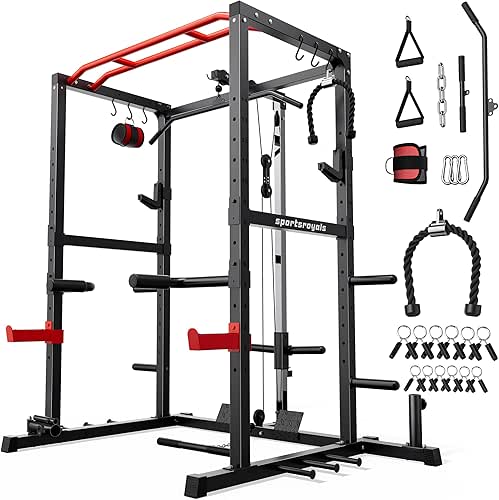
Designed for serious home lifters who want an all-in-one solution, the Sportsroyals Power Cage bundles a 1600 lbs capacity with an adjustable cable crossover system and a full slate of training attachments. You get a 50x50mm commercial steel frame, 1.5mm walls, 150lbs rack weight, and two reinforcing tabs for stability. It supports up to 1200 lbs during training and offers squat rack, lat pull-down, power tower, and dip bar. With 14 height-adjustable pillars, 360° landmine, bench press capability, and wide/narrow pull-downs, it covers squats, pulls, presses, and accessories—reducing extra gear needs. Includes storage, cushioning pads, and durable pulleys for smooth motion.
Best For: Serious home lifters seeking an all-in-one, heavy-duty power rack with integrated cable crossover and ample storage for a compact, multi-user home gym.
Pros:
- All-in-one solution with squat rack, lat pull-down, power tower, dip bars, and adjustable cable crossover, reducing need for extra equipment.
- Sturdy 50x50mm commercial steel frame, 1.5mm walls, and reinforced stability features to handle up to 1200 lbs during training.
- Comprehensive included accessories and storage (barbell and weight plate storage, multiple hooks and safety components, cushioning pads) for organized workouts.
Cons:
- Large footprint (61.6″ L x 56.0″ W x 82.6″ H) may require a spacious dedicated area.
- Assembly can be involved and may require 2–3 people for proper setup.
- Higher price point reflects premium features and all-in-one design, which may be overkill for casual lifters.
Power Cage Home Gym with Dual Pulley Cable Crossover System and Attachments

This Power Cage Home Gym combines a Smith machine, power cage, and dual pulley cable crossover in one compact unit, making it the ideal all-in-one solution for serious home strength training. You’ll enjoy space efficiency with an all-in-one design that supports squats, bench presses, rows, cable flys, dips, pull-ups, and full-body routines in 18.3 sq. ft. The system glides on premium bearings for smooth, safe lifts, with 9 adjustable heights and built-in safety stops. Two independent pulleys offer 1:1 ratio, 20 positions, and versatile crossover work. Includes complete accessories for comprehensive workouts and robust 2,000 lb capacity.
Best For: Home gym enthusiasts and individuals seeking an all-in-one, space-efficient strength training solution with versatile attachments and a high weight capacity.
Pros:
- All-in-one Smith machine, power cage, and dual pulley system save space and consolidate equipment.
- Smooth operation with premium bearings, adjustable heights, and built-in safety stops for safer lifting.
- 2,000 lb capacity and comprehensive accessory kit enable a wide range of exercises and training styles.
Cons:
- Delivered in 3 packages and may arrive on different days, potentially delaying setup.
- Requires ample floor space (18.3 sq. ft. footprint) within a dedicated area for full functionality.
- Assembly and setup may be time-consuming due to multiple components and parts included.
Power Cage Multi-Function Power Rack with LAT Pulldown and Attachments
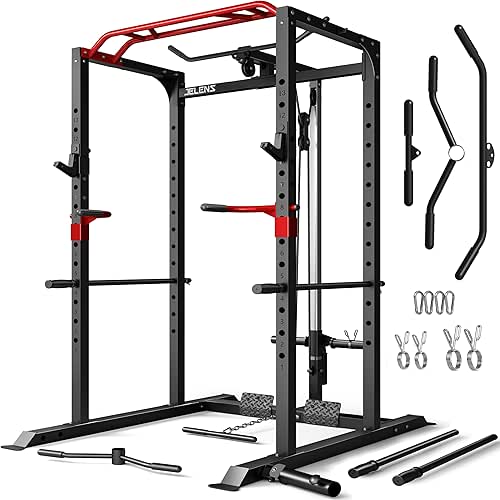
If you want a versatile home gym workhorse, this Power Cage with LAT Pulldown and attachments stands out for heavy-duty multi-function capability, supporting up to 2000 lbs and delivering a full range of exercises—from bench presses and squats to rows and pull-ups. Built from 50mm x 50mm steel, it handles demanding sessions with rust-resistant, laser-marked height adjustments across 13 settings for precise positioning. The upgraded pulley system uses a precision steel shaft and solid wire rope for smooth, quiet operation. Includes lat pulldown, cable bar, T-bar, pull-down bar, J-hooks, safeties, landmine, and counterweights for easy switching. Ships in two boxes with support.
Best For: Home gym enthusiasts seeking a heavy-duty, space-efficient power rack with integrated lat pulldown and versatile attachments for a wide range of compound and accessory movements.
Pros:
- Heavy-duty construction supports up to 2000 lbs with 50mm x 50mm steel framing for demanding workouts.
- 13 laser-marked height adjustments and a smooth, quiet pulley system enhance precision and training comfort.
- Includes a comprehensive set of attachments (lat pulldown, bars, J-hooks, safeties, landmine, counterweights) for versatile programming.
Cons:
- May be overkill for casual users or those with very limited space beyond the stated footprint.
- Assembly and setup could be time-intensive, as it ships in two boxes and requires careful installation.
- Weight and footprint require a dedicated dedicated area; not ideal for apartments with strict space constraints.
Factors to Consider When Choosing Power Racks for Home Gym
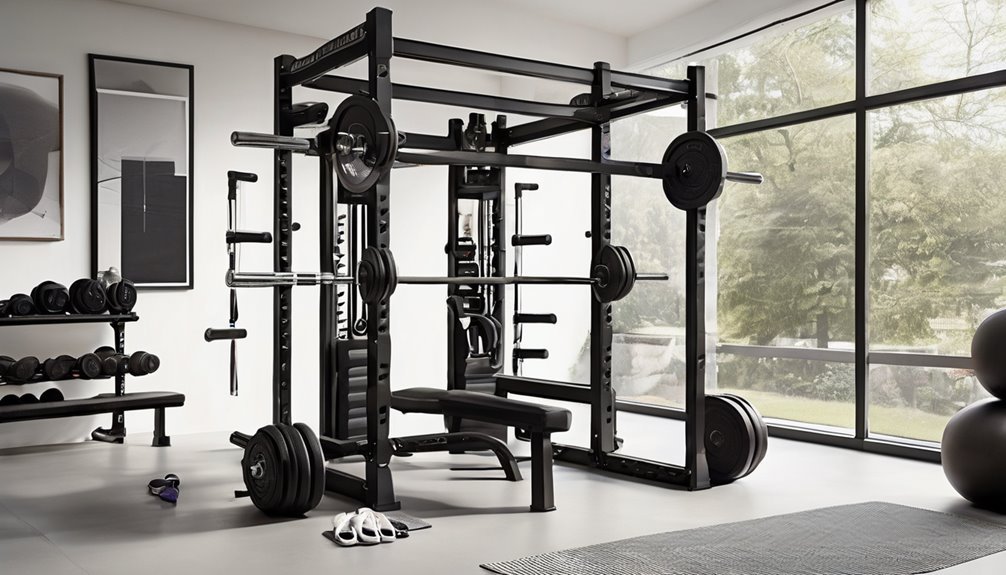
When you pick a power rack, you want solid build quality that can handle heavy lifts and long-term use. Consider weight capacity, how it fits your space, and how adjustable it is to grow with your workouts. Don’t overlook accessory versatility and space-efficient designs that still give you full range of motion.
Build Quality Matters
Build quality isn’t just a nice-to-have—it’s the backbone of safety and durability in a home gym. When you choose a rack, consider frame material and uprights, since 1.5 mm versus 2 mm steel and 50×50 mm uprights affect rigidity and safety during heavy lifts. Stability matters, too—look for wide base bases and reinforcing tabs that resist tipping under high loads. Precision features matter as well: laser-cut height markings and consistent hole spacing (1-inch or 4-inch) let you set up repeatable, accurate adjustments every session. Don’t overlook components: durable pulleys, smooth bearings, and corrosion-resistant finishes keep operation quiet and long-lasting in home environments. Finally, a robust weight capacity (1000–2000 lbs) signals true structural integrity for demanding, multi-user workouts.
Weight Capacity Needs
Weight capacity is the backbone of safe loading in a home rack, so pick a model that can handle both your current max and where you want to go next. For most home users, racks span roughly 1,000 to 2,000 pounds total capacity, so choose accordingly. For compounds like squats and bench presses, ensure the rack can handle at least 1.5–2 times your current max to account for dynamic loads and future progress. If you plan heavier cable work, dual-pulley or independent pulley systems can double usable resistance without increasing rack weight capacity. With half-racks, verify the stated capacity applies to the full assembly, not just uprights. Prioritize higher-rated capacities (1,800–2,000 lbs) and reinforced bases to reduce tipping under load as you grow.
Space Efficiency Tips
Space matters as much as strength, so opt for a half-rack or compact footprint that uses about two-thirds less space than a full-size rack although still offering multipurpose functions. To maximize efficiency, choose integrated storage features like weight plate pegs, bar holders, and handle hooks so you stay organized and reduce floor clutter. Consider whether a built-in cable pulley or cable crossover makes sense; use it only if you plan frequent cable-based work, otherwise favor modular systems to save space. Prioritize racks with foldable or easily storable attachments—dip bars, landmine, J-hooks—to minimize unused space when not in use. Finally, verify overall dimensions (length, width, height) and ensure ample walk-around room and side-to-side movement for safe transitions.
Adjustability Range
When you pick a power rack, the range of adjustability matters for safe, comfortable workouts across different lifts and users. A wide range lets you set j-hooks, safety bars, and dip handles at the right height, typically offering 9–10 positions for the rack and 3–4 for accessories. More adjustment positions—like 30 height options with 1-inch spacing—lets you align precisely for squats, bench presses, and pull-ups. Laser-cut or clearly marked height indicators speed setup and cut guesswork between sets. Independent pulley systems with many height presets (20+ positions) expand exercise variety without moving the rack. Tall overall heights (81–82 inches) plus multiple adjustable components support full-range movements while preserving safe clearance.
Accessory Versatility
Accessory versatility matters as it directly expands what you can do with a single rack. When you choose, look for adjustable compatibility with multiple attachments—J-hooks, safety bars, dip bars, landmine, and pulley systems—to broaden exercises without extra gear. Independent dual pulley systems (1:1 ratio) double weight options and support unilateral or bilateral cable work, boosting training variety. Integrated weight storage and organized attachment pegs keep accessories within reach and cut setup time, so you waste less practice and more progress. A wide range of height options (13–30+ positions or 10–14+ levels) ensures precise align for different heights and movements. A 1,600–2,000 lb capacity with robust 50x50mm or 2×2 inch tubing underpins heavy lifts and long-term versatility.
Stability & Safety
Stability and safety are the backbone of any solid home gym setup, especially for strength racks. To minimize tipping during dynamic lifts, prioritize a wide, heavy base and reinforcing tabs that resist sway. A higher weight capacity, around 1600–2000 lbs, usually signals sturdy frame construction and thicker steel, further reducing movement under load. Floor contact features matter, so look for rubber pads or reinforced footplates that distribute weight and prevent sliding on typical gym floors. Upright dimensions around 50×50 mm or larger and multiple solid connection points boost rigidity and safety during exercises. Independent pulley systems or dual-pulley configurations help balance loads, enhancing stability across movements. Choose a rack that combines these elements for dependable performance and safer training.
Cable/Pulley System
A dual or independent pulley system lets each side move with 1:1 resistance, enabling unilateral and bilateral exercises and true weight equivalence to loaded plates. A solid cable/pulley setup supports heavier lifts with higher weight capacity, reducing the risk of system failure during demanding movements. Upgraded pulleys and high-strength steel cables deliver smoother movement, less friction, and quieter operation for repeated cycles. A cable crossover feature expands exercise options, allowing simultaneous multi-muscle work and versatile cable angles. Independent dual pulleys enable supersets and drop sets without re-rigging, boosting training efficiency in a home gym. Look for systems designed for 2000 lb capacity to ensure longevity under heavy use, and verify smooth engagement across the full range of motion. Select configurations that match your rack’s footprint and intended workouts.
Assembly & Warranty
When you’re choosing a power rack, clarity on assembly and warranty matters just as much as raw capacity. Check if the rack ships in multiple boxes and whether assembly demands 2–3 people or professional setup. Look for detailed installation manuals or videos and whether the manufacturer offers customer support during assembly. Verify the stated warranty period (e.g., 1–2 years) and what components it covers (frame, pulleys, attachments). Confirm delivery packaging practices (separate boxes to reduce transit damage) and estimated delivery timeline. Ensure there’s clear information on weight capacity and whether assembly includes integrated storage or cable/pulley alignment features to prevent misassembly. Clear guidance on returns or service visits completes confidence in your investment.
Frequently Asked Questions
Do All Racks Fit Standard 7-Foot Barbells?
Not all racks fit a standard 7-foot barbell. Check the rack’s barbell depth, hole spacing, and J-cup height to ensure compatibility; many racks accommodate 7-foot bars, but some are optimized for shorter or longer variants. Verify specs yourself.
How Much Space Is Needed for Full Movement?
“Measure twice, cut once.” You’ll need about 7 feet of clearance in front and behind, plus side room for safety, adjustability, and rack hooks, so you can move freely without bumping walls or equipment during lifts.
Are Steel Racks Worth the Extra Cost?
Yes, steel racks are worth the extra cost despite they’re stiffer, safer, and handle heavier loads longer. You’ll notice steadier lifts, fewer flexes, and better durability, making them more economical over time because higher upfront price.
What Maintenance Keeps Racks Safe Long-Term?
You’ll keep racks safe long-term by inspecting bolts and welds weekly, lubricating moving parts, cleaning dust, and replacing worn components promptly; store on level ground, torque fasteners as recommended, and follow manufacturer maintenance schedules without skipping checks.
Can Racks Be Upgraded With Future Attachments?
Yes, racks can be upgraded with future attachments. You’ll swap or expand components like adjustable benches, safety arms, and monolifts, while preserving compatibility through standardized mounting, weight capacities, and secure fastenings, ensuring continued stability as you progress.
Conclusion
You stride into your garage turns into a temple of iron, rack uprights gleaming like sentinels. The weight plates murmur as you grip the bar, chalk frosting your palms. With every rep, cables hum and attachments click into place, guiding you toward power you can feel in your bones. Choose a rack that fits your space, your budget, your goals, and watch your workouts unfold like a sunrise over a dedicated, rock-solid routine. Your best gains await.