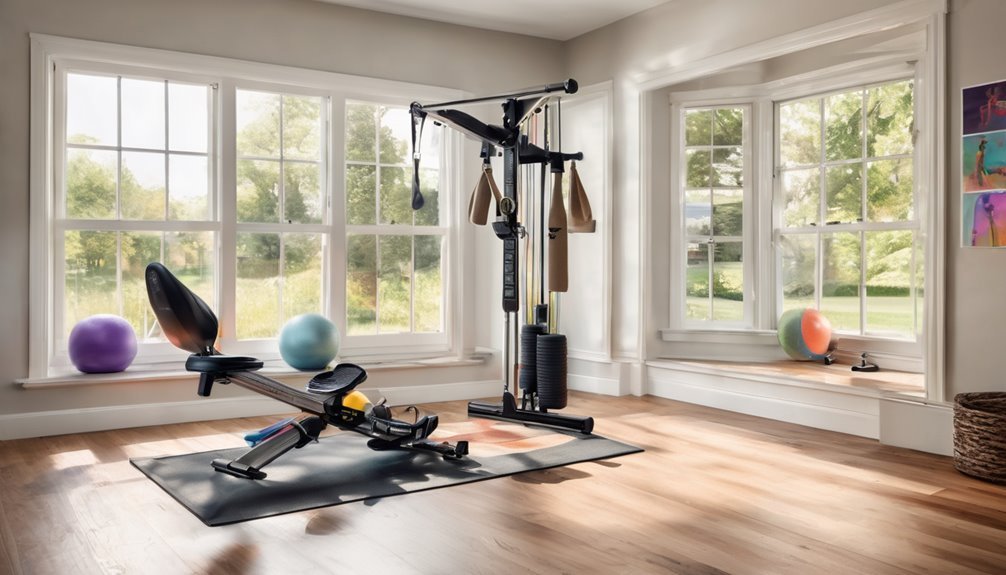
To establish a versatile home gym in 2025, consider the VINSGUIR Ab Roller Wheel for core strength, a Push Up Board with resistance bands for full-body workouts, the Balency Hip Thrust Belt for glutes, a multifunctional workout station with a weight stack for diverse exercises, and the SincMill Home Gym for complete, easy-to-assemble routines. These options suit all fitness levels and maximize space. Keep exploring to find out which gear best fits your goals and space.
Key Takeaways
- Choose versatile, space-saving equipment like multi-function stations and foldable gear to maximize limited home workout areas.
- Prioritize safety features such as non-slip handles, padded surfaces, and adjustable safety stops for injury prevention.
- Select equipment suitable for all fitness levels, with adjustable resistance and customizable settings to support gradual progress.
- Focus on durability and quality, opting for sturdy materials and reliable brands to ensure long-term use and safety.
- Consider your specific fitness goals—strength, endurance, or flexibility—and pick equipment that aligns with those objectives.
VINSGUIR Ab Roller Wheel for Home Gym Workouts
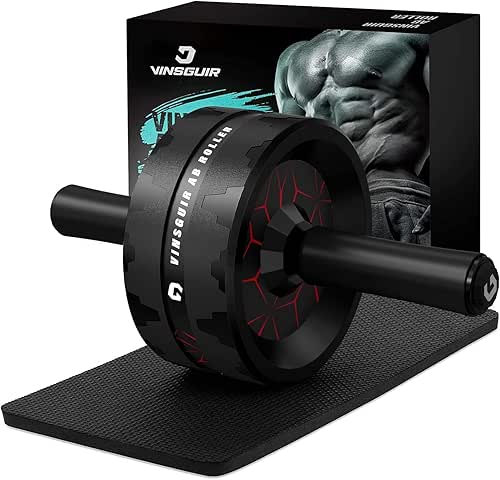
Looking for an effective core workout tool that’s perfect for home use? The VINSGUIR Ab Roller Wheel is a fantastic choice. Its dual-wheel design provides extra support and stability, making your workouts safer and more effective. The included knee pad adds comfort, so you can focus on your abs, hip flexors, and back muscles without discomfort. Made with non-slip EVA rubber handles, it guarantees a secure grip during intense sessions. Whether you’re a beginner or advanced, this roller supports up to 440 pounds, guaranteeing safety and durability. Compact and portable, it’s easy to incorporate into your home gym routine.
Best For: fitness enthusiasts of all levels seeking a stable, comfortable, and versatile core workout tool for home, office, or outdoor use.
Pros:
- Dual-wheel design provides enhanced support and stability during exercises
- Includes a knee pad for added comfort and injury prevention
- Supports up to 440 pounds, ensuring durability and safety for various users
Cons:
- May require some space for safe and effective use at home
- Not suitable for users with severe joint or back issues without proper guidance
- The compact size might limit certain advanced or wide-range movements
Push Up Board and Home Gym Workout Equipment with Resistance Bands and Ab Roller Wheel

If you want a versatile and space-saving solution for full-body workouts at home, the Push Up Board combined with resistance bands and an ab roller wheel is an excellent choice. This portable system includes a foldable push-up board, a three-section bar, resistance bands, ankle straps, a door anchor, and an ab roller wheel, covering all your workout needs. Its color-coded design targets specific muscle groups for maximum efficiency, improving effectiveness by 80%. Compact and lightweight, it replaces bulky gym equipment, making it perfect for any space. Suitable for all fitness levels, it supports upper and lower body training, strength, and cardio exercises, offering a thorough home workout solution.
Best For: individuals seeking a versatile, space-efficient home workout system suitable for all fitness levels to target multiple muscle groups effectively.
Pros:
- Fully portable and lightweight, easy to store and transport
- Offers comprehensive full-body workouts with adjustable resistance and multiple accessories
- Color-coded design enhances targeting of specific muscle groups for increased efficiency
Cons:
- May require time to learn proper technique for all attachments and exercises
- Limited by available space at home, may not replace heavy gym equipment for advanced training
- Some users might find the variety of accessories overwhelming initially
Balency Hip Thrust Belt for Dumbbells and Weights

The Balency Hip Thrust Belt for Dumbbells and Weights is an ideal addition to your home gym if you want a safe, comfortable way to perform glute-focused exercises. Its padded sides prevent bruising, while anti-slip padding keeps weights secure and prevents slipping. The belt fits most body types with its 22.4 x 4.7-inch dimensions. It’s designed to hold heavy weights steadily, reducing shaking and enhancing safety. Plus, its foldable, space-saving design makes it portable for home, gym, or travel use. Setting up is quick—simply attach dumbbells or plates, then secure with the loop straps, so you can focus on your workout.
Best For: individuals seeking a safe, comfortable, and portable accessory to enhance glute and lower-body workouts at home or on the go.
Pros:
- Padded sides provide extra comfort and prevent bruising during exercises.
- Anti-slip padding ensures weights remain secure and stable.
- Foldable and compact design makes it easy to store and transport.
Cons:
- May not fit very small or very large body types despite its adjustable dimensions.
- Requires manual setup to attach and secure weights before each use.
- Limited to supporting dumbbells, plates, and kettlebells, not suitable for all weight types or larger equipment.
Home Gym Multifunctional Workout Station with 150LBS Weight Stack
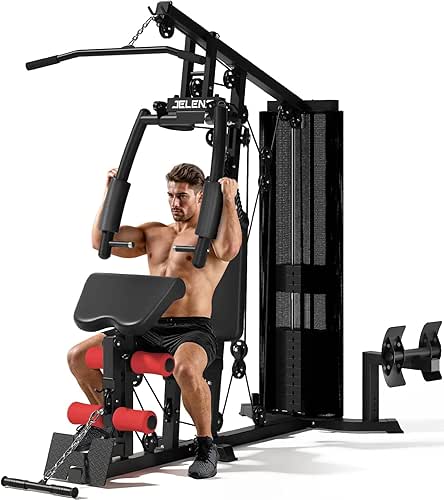
This multifunctional workout station is ideal for home fitness enthusiasts who want a versatile, space-saving solution. With an all-in-one setup, it supports exercises like leg stretches, rows, chest flys, presses, calf training, and back extensions. The 150LBS weight stack, with over 11 adjustable plates, lets you customize your workout intensity. Made from durable, rust-proof steel, it features a stable U-shaped base with shock-absorbing pads. The pulley system offers high, medium, and low options for varied exercises, while adjustable seats and removable pads ensure a personalized, comfortable fit. Easy to install, it’s perfect for building an all-encompassing home gym.
Best For: home fitness enthusiasts seeking a versatile, space-saving gym system with customizable workouts and durable construction.
Pros:
- All-in-one design supports a wide range of exercises including leg stretches, rows, chest flys, and more.
- Durable, rust-proof steel frame with stable U-shaped base and shock-absorbing pads for safety and floor protection.
- Adjustable components such as seat height, leg extension, and butterfly arms allow personalized comfort and targeted training.
Cons:
- Assembly may require some time and effort despite detailed instructions.
- Limited to 150LBS weight stack, which might not satisfy advanced strength trainers.
- Space needed for full setup might be significant depending on room size.
SincMill Home Gym Multifunctional Workout Equipment

Designed for those seeking a complete home workout solution, the SincMill Home Gym Multifunctional Workout Equipment offers versatility and sturdy construction. Its thick steel frame and weight guards guarantee durability, even under heavy loads. Developed by pros with over 20 years of experience, this equipment features a smart design that allows you to switch parts for pushing or clamping without manual adjustments. The adjustable elbow pad height enhances comfort, while the clear installation instructions and tutorial video make setup quick—under 30 minutes. Plus, their professional support team is committed to resolving any issues, so you can focus on achieving your fitness goals with confidence.
Best For: individuals looking for a versatile, durable, and easy-to-assemble home gym solution to achieve full-body workouts comfortably at home.
Pros:
- Crafted with a thick steel frame and weight guards for enhanced durability and safety.
- Features a smart, adjustable design allowing quick switching between parts for different exercises without manual adjustments.
- Comes with comprehensive installation instructions and a tutorial video, enabling setup in under 30 minutes.
Cons:
- May require sufficient space at home to accommodate the full equipment setup.
- Adjustments and assembly might be challenging for users unfamiliar with gym equipment.
- As a multifunctional piece, it may have a higher price point compared to basic home gym options.
Factors to Consider When Choosing Workout Gym Equipment for Home
When selecting gym equipment for your home, you need to think about how much space you have and your budget. Consider your workout goals to choose versatile gear that meets your needs safely. By focusing on these factors, you’ll create an effective and comfortable workout environment.
Space Requirements
Before choosing your home gym equipment, it’s essential to measure your available space carefully. Take precise measurements of the room’s dimensions to guarantee your equipment fits comfortably without overcrowding. Consider each piece’s footprint and storage needs, especially if space is limited or you want a multi-purpose setup. Opt for foldable or compact equipment that can be easily stored when not in use, freeing up space. Make certain to allocate enough clearance around your equipment for safe, unrestricted movement during workouts. Prioritize versatile machines that can support multiple exercises, maximizing space efficiency. Remember, a well-planned layout will keep your workout area functional, safe, and inviting, making it easier to stay consistent with your fitness routine.
Budget Constraints
Evaluating your budget early on helps guarantee you select gym equipment that balances quality and affordability. Determine how much you’re willing to spend, and stick to it. Consider not only the initial cost but also the expenses for accessories, maintenance, or replacements over time. Look for equipment that offers good durability and safety without breaking the bank. Multi-function machines can be a smart investment, providing multiple workout options in one device and saving space and money. Prioritize features that directly support your fitness goals, so you avoid spending on non-essential items. By being mindful of your budget, you can find equipment that delivers value, helping you stay consistent without overspending. Keeping your financial limits in mind ensures your home gym is both practical and effective.
Workout Goals
Grasping your primary fitness goals is vital to choosing the right home gym equipment. Whether you’re aiming to build strength, boost endurance, or tone muscles, selecting equipment that corresponds with these goals guarantees effective workouts. Decide if your focus is on cardio, strength training, flexibility, or a combination, so your gear supports all activities you want to pursue. Consider your current fitness level, and pick equipment that allows for gradual progression to prevent injuries and encourage steady improvement. Moreover, assess the space available in your home to make sure the equipment fits comfortably and is easy to store. Prioritize versatile, multi-functional options that can target multiple muscle groups and adapt to different routines, maximizing your workout potential within your space and budget.
Versatility of Equipment
Choosing adaptable gym equipment means selecting pieces that support multiple exercises across different muscle groups, helping you get the most out of your workouts. Look for equipment with adjustable features like resistance levels or component positions, so you can tailor routines to your fitness level and goals. Incorporating multifunctional tools, such as combined resistance bands and weight stacks, allows for thorough, full-body workouts without needing separate devices. Equipment with interchangeable attachments or modules gives you the flexibility to customize your routines easily. Moreover, compact, all-in-one systems maximize space efficiency while offering diverse workout options. By choosing versatile equipment, you guarantee your home gym adapts to your changing needs and keeps your workouts engaging and effective.
Safety Features
When selecting versatile gym equipment for your home, it’s equally important to prioritize safety features that help prevent accidents and injuries. Look for equipment with non-slip handles, secure straps, and stable bases to improve stability during workouts. Padded or cushioned surfaces reduce the risk of impact injuries, making your sessions safer. Adjustable safety stops and lock-in mechanisms guarantee equipment stays secure, preventing unexpected movements. Choose machines with clear weight limits and sturdy construction to minimize the chance of structural failure or collapse. Additionally, equipment that includes clear instructions and safety warnings helps you use it properly and avoid misuse-related injuries. Prioritizing these safety features guarantees a safer workout environment, giving you peace of mind as you focus on reaching your fitness goals.
Ease of Use
Selecting gym equipment that’s easy to set up and operate can make a significant difference in maintaining your workout routine. Look for machines with simple assembly instructions and minimal setup time, so you can start exercising quickly. Adjustable features, like height or resistance levels, should be easy to modify without needing complex tools, making your workouts more versatile. Prioritize ergonomic designs, such as padded handles and stable bases, to boost comfort and reduce injury risk. Choose versatile equipment that supports multiple exercises, saving space and simplifying your workout plan. Finally, guarantee the controls are clear and user-friendly, with safety mechanisms in place. This combination of features keeps your workouts smooth, safe, and hassle-free, helping you stay motivated and consistent at home.
Storage Solutions
Maximizing space in your home gym requires careful consideration of storage solutions that keep your equipment organized and accessible. Choose compact, foldable equipment to save space, especially in smaller gyms. Multi-use devices that combine functions help reduce clutter and eliminate the need for multiple machines. Wall-mounted or vertical storage options keep your gear off the floor and within easy reach, making your workout area more efficient. Look for equipment with built-in storage compartments or accessories to prevent clutter and keep everything tidy. Lightweight, portable options are ideal since they can be moved or stored away when not in use, freeing up space for other activities. Prioritizing smart storage solutions guarantees your home gym remains organized, functional, and inviting.
Frequently Asked Questions
What Is the Ideal Budget for a Comprehensive Home Gym Setup?
You should budget around $1,500 to $3,000 for a complete home gym setup, depending on your equipment choices and space. Prioritize versatile gear like dumbbells, a bench, and a cardio machine to maximize your investment.
How Much Space Is Needed for the Most Versatile Equipment?
Space specifics shape your setup; roughly 150 to 200 square feet suits most versatile equipment, allowing room for movement, machines, and mats. Be bold, balance, and build your bespoke, bright, and lively home gym.
Are There Equipment Options Suitable for Seniors or Injury Recovery?
Yes, you can find equipment like recumbent bikes, resistance bands, and seated elliptical trainers that are perfect for seniors or injury recovery. These options offer low-impact exercise, support stability, and help you stay active safely at home.
How Often Should I Replace or Upgrade My Home Gym Equipment?
You should replace or upgrade your home gym equipment every 3 to 5 years, or sooner if it shows signs of wear, damage, or no longer meets your fitness needs. Regular updates keep your workouts safe and effective.
Can Beginner-Friendly Equipment Effectively Support Advanced Training Goals?
Yes, beginner-friendly equipment can support advanced training goals if you focus on proper form, progressive overload, and varied routines. You can gradually increase intensity and incorporate more challenging exercises, making your workouts adaptable and effective as you advance.
Conclusion
Choosing the right equipment transforms your home gym from cluttered to capable. Whether you prefer the simplicity of an ab wheel or the versatility of a multifunctional station, every piece has its place. Remember, it’s not just about having the best gear but matching it to your goals. So, invest wisely—because in your home, every workout counts, and the right equipment can make all the difference between dreaming and achieving.